

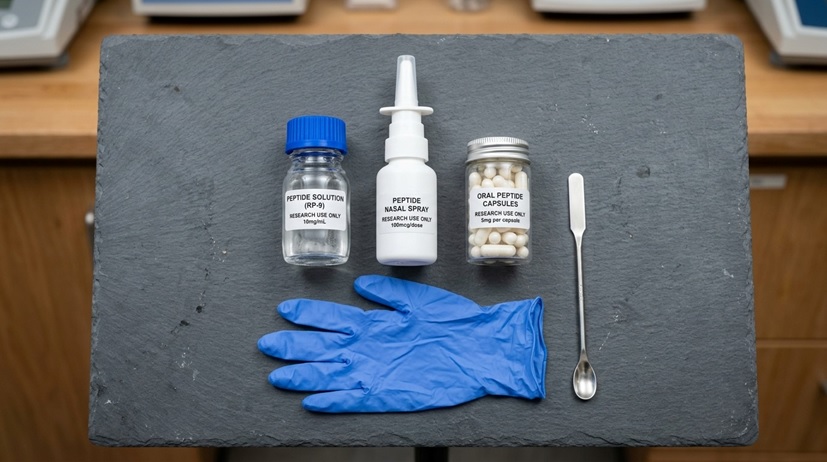
Every research peptide format comes down to one underlying decision, whether you prepare the compound yourself or receive it ready to use. Lyophilized vials sit on one side of that line, and pre-formulated formats like nasal sprays and capsules sit on the other. On peptides.com you can see both approaches in the same catalog, with the large vial selection representing the do-it-yourself side and products such as the Semax and TB-500 nasal sprays and the 5-Amino-1MQ capsules representing the ready-to-use side. Choosing between them is really a question about what your study needs.
This comparison keeps to laboratory research framing. All products discussed are research use only and not for human or animal consumption.
The core difference: who prepares the compound
A lyophilized vial contains freeze-dried peptide powder that you reconstitute before use. You add the solvent, you set the concentration, and you decide how to aliquot the result. A pre-formulated product, whether a nasal spray or a capsule, arrives finished. The formulation and the amount are fixed when the product is made, so there is nothing to prepare.
That single distinction drives everything else. Preparing the compound yourself gives you control. Receiving it ready gives you convenience. Neither is universally better, and the right pick depends entirely on which of those two things your research values more.
The case for lyophilized vials
Control is the headline advantage of vials, and it shows up in several ways. Because you reconstitute the powder yourself, you choose the concentration to match your protocol rather than accepting whatever a manufacturer selected. You know exactly what went into the solution, which supports clean, well-documented work. And you can split the reconstituted peptide into single-use aliquots, freezing them to avoid the repeated freeze-thaw cycles that degrade material over time.
Shelf life is the second advantage. Lyophilized powder, kept dry and frozen, is highly stable and can remain usable for long stretches. That makes vials well suited to compounds you want to keep on hand, and it is a big part of why the vast majority of the peptides.com catalog, from SS-31 and MOTS-c to BPC-157 and the incretin compounds, is offered as vials.
The cost of all this is effort. Vials require careful reconstitution, correct solvent choice, and disciplined storage. For researchers who value precision, that effort is the point, not a drawback.
The case for pre-formulated formats
Pre-formulated products flip the priorities. Their advantage is that the preparation is already done, which removes both work and opportunities for error. There is no solvent to add, no concentration to calculate, and no reconstitution technique to get right. You use the product as supplied.
This convenience is genuinely valuable in the right context. When the delivery route itself is part of the study, a format built for that route removes a variable. The Semax and TB-500 nasal sprays fit intranasal research this way, and the 5-Amino-1MQ capsules fit oral-route research. A ready formulation also provides consistency from unit to unit, which can support reproducibility when you do not need to vary the concentration.
The trade-off is flexibility and, often, shelf life. A fixed formulation cannot be adjusted, and a product already in solution does not enjoy the long dry-state stability of a lyophilized powder. You accept those limits in exchange for the convenience.
Matching format to research goal
The decision becomes straightforward once you frame it around your goal. If your work depends on setting specific concentrations, keeping compounds stable for extended periods, or aliquoting to protect a batch, lyophilized vials are the natural fit. The control and shelf life are worth the preparation.
If your work centers on a specific delivery route, benefits from removing preparation steps, or values a consistent ready-made unit over adjustable dosing, a pre-formulated format fits better. The convenience directly serves the research rather than just saving time.
Many labs end up using both, choosing vials for compounds that need flexible preparation and reaching for sprays or capsules when a specific route or a ready unit suits the design. The catalog structure on peptides.com reflects that reality, keeping vials as the deep default while offering curated pre-formulated options where they make sense.
What does not change between formats
Whichever side of the line you land on, the quality standards stay identical. A stated purity, a published certificate of analysis tied to the batch, and third-party testing matter just as much for a nasal spray or capsule as for a vial. peptides.com applies the same documentation across all its product types, so choosing a format is about fit, not about accepting less transparency. A convenient format with no documentation is a bad trade, and a controlled format with no documentation is no better. Insist on the evidence regardless.
The bottom line
Lyophilized vials and pre-formulated products are not competitors so much as tools for different jobs. Vials give you a blank slate with maximum control and long storage life, at the cost of preparation. Nasal sprays and capsules give you a finished product aligned with a specific route, at the cost of flexibility. Decide what your study cannot compromise on, control or convenience, and the right format usually picks itself. Then hold whichever you choose to the same standard of documented, verifiable quality.
Frequently asked questions
What is the difference between lyophilized vials and pre-formulated peptides?
Lyophilized vials contain freeze-dried powder that you reconstitute yourself, controlling the concentration. Pre-formulated products like nasal sprays and capsules arrive finished, with a fixed formulation and no preparation, trading control for convenience.
Are lyophilized vials better than ready-to-use formats?
Neither is universally better. Vials offer control over concentration and long dry-state shelf life, which suits precision work. Pre-formulated formats offer convenience and consistency, which suits research centered on a specific delivery route or one that benefits from fewer preparation steps.
Do pre-formulated peptides last as long as lyophilized vials?
Generally no. Lyophilized powder kept dry and frozen is highly stable for long periods, while a product already in solution has a shorter, product-specific shelf life. Capsules fall in between, though all formats should be stored per their provided guidance.
This article is for educational purposes and compares research peptide formats for laboratory use. All products referenced are for research use only and are not intended for human or animal consumption or to diagnose, treat, cure, or prevent any disease.