

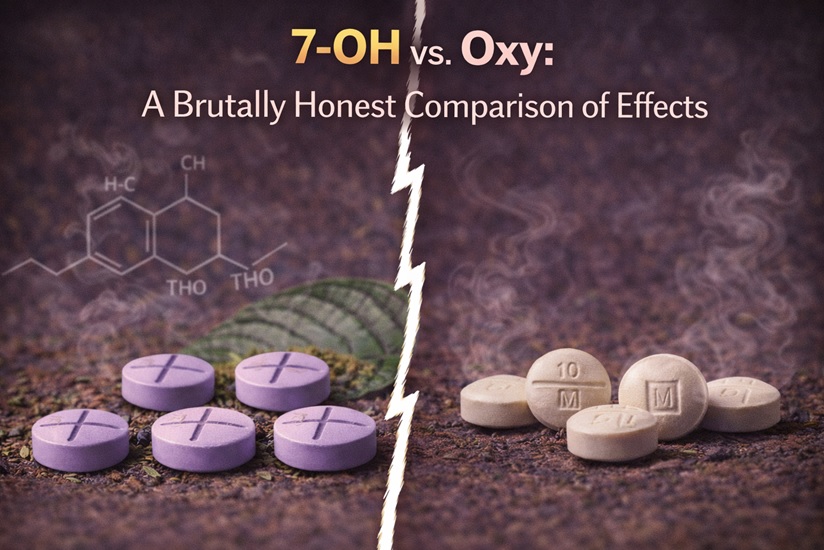
Disclaimer: This article is for informational and harm-reduction purposes only. It does not constitute medical advice. 7-Hydroxymitragynine (7-OH) is a potent alkaloid, and Oxycodone is a Schedule II controlled substance. Both carry risks of dependency and adverse effects. Always consult a medical professional for pain management.
Let’s stop dancing around the subject.
If you are reading this, you likely aren’t looking for a “mild botanical tea” to help you relax after yoga. You are probably in pain—real, grinding, chronic pain—and the Tylenol isn’t cutting it. You might be one of the millions of people who have been cut off from their pain management prescriptions due to the tightening grip of CDC guidelines. Or perhaps you are simply looking for a legal alternative that actually works without requiring a humiliating monthly visit to a pain clinic.
You’ve heard the whispers on Reddit forums and in private groups: “7-OH feels just like Oxy.”
Is it true? Is this legal plant alkaloid really comparable to one of the most powerful prescription opioids on the planet? Or is it just marketing hype from vendors trying to sell overpriced tablets?
We are going to break down the comparison without the fluff. No “wellness” euphemisms. Just a direct, head-to-head analysis of onset, duration, euphoria, and pain relief capabilities.
The Pharmacology: Why They Are Even Comparable
To understand why users compare a gas station supplement to a Schedule II narcotic, you have to look at the receptors.
Oxycodone is a semi-synthetic opioid synthesized from thebaine, an alkaloid found in the Persian poppy. It is a full agonist at the mu-opioid receptor. Think of it like a key that fits perfectly into a lock and turns it all the way. This full activation results in profound analgesia (pain relief), sedation, and that characteristic warm blanket of euphoria. It also depresses the central nervous system, slowing down breathing, which is why it can be fatal in overdoses.
7-Hydroxymitragynine (7-OH) is a natural alkaloid found in the Kratom plant (Mitragyna speciosa). Unlike regular Kratom (Mitragynine), which is a partial agonist, 7-OH acts much more like a full agonist. In fact, studies suggest it is 13 times more potent than morphine by weight [1].
However, 7-OH has a unique trick: it is a “biased” agonist. It activates the G-protein signaling pathway (which kills pain) but recruits very little beta-arrestin (the pathway responsible for respiratory depression and constipation) [2].
The Translation: 7-OH hits the same “feel good” and “kill pain” buttons in your brain as Oxy, but it doesn’t hit the “stop breathing” button nearly as hard. This pharmacological profile is the “Holy Grail” that drug companies have been trying to synthesize for decades—and nature made it in a leaf.
Round 1: The Onset (The “Rush”)
Oxycodone:
- Speed: Fast. On an empty stomach, immediate-release Oxycodone kicks in within 15-30 minutes.
- The Feeling: It is often described as a “clean” energy lift followed by a wave of warmth. It’s sharp and distinct. You know exactly when it hits.
7-OH:
- Speed: Surprisingly fast. Sublingual tablets (held under the tongue) can hit in 10-15 minutes. Swallowed tablets take 30-45 minutes.
- The Feeling: The onset is often described as “heavier” than Oxy. It lacks that initial “speedy” rush that some Oxy users get. Instead, it feels like a rapid melting of tension. One Reddit user described it as: “It doesn’t have the ‘click’ that Oxy has where the lights suddenly turn on, but within 20 minutes, you realize you just don’t care about the pain anymore.”
Winner: Oxycodone for the “rush,” but 7-OH for speed of absorption (if taken sublingually).
Round 2: Pain Relief (Analgesia)
This is the metric that matters most to chronic pain patients.
Oxycodone:
- Effectiveness: The gold standard. It creates a dissociation from pain. The pain might still be there distantly, but it doesn’t hurt. It is highly effective for post-surgical pain, bone pain, and nerve pain.
- Consistency: Pharmaceutical grade means 10mg is always 10mg. You know exactly what you are getting.
7-OH:
- Effectiveness: Shockingly comparable. For many users, 15mg of 7-OH provides relief equivalent to 10-15mg of Oxycodone. It is particularly good at deep, throbbing body pain.
- The Difference: 7-OH seems to have a “ceiling effect.” Taking 30mg might feel twice as strong as 15mg, but taking 60mg won’t necessarily feel four times as strong—it will just make you sleepy and nauseous. Oxycodone continues to scale up in effects (and danger) the more you take.
Winner: Tie. For moderate to severe chronic pain, 7-OH holds its own against prescription doses. For extreme, acute trauma (like a broken femur), Oxycodone still reigns supreme due to the lack of a ceiling effect.
Round 3: Euphoria and Mood
Let’s be real: the mood lift is a major reason people use these substances.
Oxycodone:
- The Vibe: Intense, chatty, confident euphoria. It makes boring tasks fun. It makes you want to call your friends. It is a very “social” high.
- The Downside: It can make you irritable (“opiate rage”) as it wears off.
7-OH:
- The Vibe: A warmer, more sedating euphoria. It feels more “cozy” than “energetic.” It is less likely to make you want to clean your house and more likely to make you want to watch a movie.
- The “Wobbles”: If you overshoot the sweet spot with 7-OH, you don’t just get higher. You get the “wobbles”—dizziness, difficulty focusing your eyes, and nausea. This acts as a natural deterrent to chasing the high too far.
Winner: Oxycodone for social energy; 7-OH for relaxation and anxiety relief.
Round 4: Duration and “Legs”
Oxycodone:
- Duration: Immediate release lasts 4-6 hours.
- The Crash: The comedown can be abrupt, leading to cravings for a redose.
7-OH:
- Duration: Shorter. Most users report the peak effects last only 3-4 hours.
- The Crash: Because it has a shorter half-life, the urge to redose comes sooner. This is the biggest complaint among 7-OH users—it can get expensive quickly if you are trying to maintain relief all day.
Winner: Oxycodone. 7-OH has “short legs,” meaning you need to dose more frequently.
Round 5: Side Effects and Safety
Oxycodone:
- Respiratory Depression: High risk. This is what kills people.
- Constipation: Severe. It paralyzes the gut.
- Addiction Potential: Extremely high.
7-OH:
- Respiratory Depression: Low risk (due to beta-arrestin bias). It is much harder (though not impossible) to stop breathing on 7-OH alone.
- Constipation: Present, but generally less severe than Oxy.
- Addiction Potential: Moderate to High. Do not let the “natural” label fool you. Your body’s opioid receptors do not care if the molecule came from a poppy, a lab, or a leaf. If you take 7-OH daily, you will develop a physical dependence. The withdrawal is real, and it feels very similar to mild opioid withdrawal (restless legs, runny nose, insomnia).
Winner: 7-OH. It is safer from a lethal overdose perspective, but do not underestimate the addiction risk.
The Verdict
Is 7-OH “Legal Oxy”?
Yes and No.
It is the closest thing to a prescription opioid you can buy without a script. The pain relief is real, the euphoria is comparable, and for many, it is a viable exit ramp from the pharmaceutical system.
However, it is not a free lunch. It carries real risks of dependency, tolerance builds fast, and the short duration can lead to frequent redosing.
If you are an adult in pain who has been abandoned by the medical system, 7-OH is a powerful tool. But treat it with the same respect you would treat a bottle of Percocet. Just because you bought it online or at a smoke shop doesn’t mean it’s weak.
Start low (half a tablet), go slow, and never mix with alcohol or benzodiazepines.
Ready to explore high-purity, lab-tested 7-OH tablets? Visit 7oh.com to see the range of potencies available.
Sources
[1] [PDF] 7-hydroxymitragynine, or 7-OH – ToxTalks: (med.virginia.edu)
[2] Respiratory effects of oral mitragynine and oxycodone in a rodent … (pmc.ncbi.nlm.nih.gov)